


1. Bee colony inspection
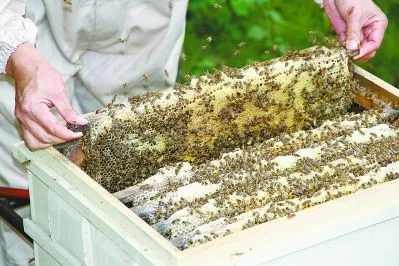
Through the inspection of the bee colony, we can grasp the changes of the bee colony, so that we can take timely measures and make adjustments to create favorable living conditions for the bees. The inspection methods are divided into out-of-box inspection and out-of-box inspection. To avoid bee stings, wear light-colored clothing and a face shield when unpacking to inspect the colony. People should turn their backs to the sun. When starting the auxiliary box cover, first use a scraper to gently pry it, and then push the auxiliary cover with your fingers to separate it from the propolis stuck to the box mouth. Flip the sub cover and place it flat in front of the beehive. One end is placed on the door of the nest, so that the bees on the auxiliary cover can climb back into the nest. Use a scraper to gently move the partition and nest frame to separate the frame ears from the grooves of the box body. Use the thumbs and forefingers of both hands to pinch the frame ears at both ends, and carefully lift the nests vertically. Be careful not to rub the combs against each other to avoid scratching the queen bee or irritating the bees. There are two ways to check the nests.

①It is to raise the nest to the height of the sight, first look at the side that is facing, then turn the beam on the nest as the axis to see the other side. Note that the spleen is always vertical to the ground when turning over to prevent honey juice and pollen from falling out of the nest.
② It is to first look at the side facing the line of sight, then lower the nest, tilt the upper part of the nest 45 degrees to the line of sight, and look at the other side.
When checking the spleen, it must be carried out above the beehive, especially the double king group. It is best to observe it above the side where the spleen is lifted to avoid the queen bee falling off and causing losses. Because the bees are crowded, it is not conducive to observation. When the spleen raises half of the box mouth, use the wrist force to quickly vibrate up and down a few times, and use inertia to shake off the bees. If there are many remaining bees on the comb, gently brush with a soft bee brush.
2. What needs to be checked
①To check whether the queen bee exists. The spleen is lifted from the center of the colony, and if neither the queen nor the eggs can be seen, the bees crawl around and make a flapping cry. This is how the colony loses its queen. If there are many eggs in the nest, and many of them are on the wall, it is very messy, indicating that the queen has been lost for a long time, and the worker bees have begun to lay eggs. It takes two to three times to check to confirm that there is indeed no queen bee before putting in a new queen. Otherwise, once two queen bees meet, both will suffer and farmers will suffer losses.

②Check the queen bee laying eggs. Open the box cover, the bees work in an orderly manner, and eggs can be seen on the comb, indicating that the queen bee is laying eggs. In a single queen bee colony, the ratio of eggs, larvae, and lids should be 1:2:4. That is: one egg spleen, 2 worm spleens, 4 sealed lid spleens, and 1-2 frames of honey powder spleen. If the egg laying area on the spleen is large, it indicates that the queen bee lays eggs vigorously and the colony is normal. If the queen bee has a small breast and abdomen, darkened color, lameness, and lack of wings, it indicates that the queen bee is of inferior quality. If the spleen area is small, the colony develops slower than other colonies, indicating that the queen bee has poor egg-laying ability, or the egg-laying is at a low ebb.

③Check the relationship between the bee and the comb. When the auxiliary cover is opened, if you find that the auxiliary cover, the outside of the partition, and the side spleen are crowded with bees, it means that there are more bees than the nest and spleen needs to be added. If there are few bees on the comb and there are no bees on the partition, it means that there are more bees in the comb. If there are many bees on the clapboard and few bees on the spleen, it means that the temperature in the nest is high and the humidity is low, and the bees are separated from the spleen.

④Check the storage of honey in the box. When the cover of the nest is opened, the aroma of honey can be smelled, and the upper part of each nest has a raised white beeswax honeycomb cover. Lift the side spleen and feel heavy. Indicates that there is enough honey in the box. If the bees show anxiety or panic after opening the box, the spleen feels light, and some bees fall, it means that there is a lack of honey in the box. No disease, but the bees on the spleen are not neat, indicating that there was a lack of honey. If the spleen has the phenomenon of abandoning the bees, it indicates that the lack of honey is serious.


